
A high-end wall clock should clearly show the time in a room. Choosing a clock involves many factors, including the size of the wall, the aesthetic of the room, the distance from which the clock will be viewed, lighting, the user’s expectations of movement, and real-world procurement issues.
Start with how you will see and use the clock. Measure up the wall and the surrounding furniture. Compare the size of the clock’s dial, the clock’s frame, and the length of its hands to the other items in the room and to the finishes on the other items in the room. Simple proportion and restraint are generally better than covering everything with decoration.
How to Choose a Luxury Wall Clock for Your Room
Match the clock’s visual role to the room
Large wall spaces can carry simple contrasting clocks or unusual face shapes, whereas very narrow walls are better suited to very slim clocks with simple frames and clear margins. Also, as a clock is a central feature of a room’s furniture, it should be positioned at the center of the furniture composition, not simply placed in the center of the wall space.
Consider daily routines and viewing conditions
Think about where in your home people will be checking the time – on a sofa, desk, in a bedroom or from a doorway. A high-contrast face is easiest to read from a distance, whereas a decorative face is best at closer viewing distances. Movement also becomes more relevant in bedrooms, studies, and reading corners.
Which Wall Clock Styles Suit a Modern Interior?
Choose clear numerals for easy everyday reading
For places where you need to check the time quickly, a clean metal case with clearly marked clock faces can provide reading ease with a minimal aesthetic. The SZZ0098 modern metal wall clock is designed with silent, non-ticking mechanisms, so the modern appearance of this timepiece makes it suitable for the living room, bedroom, kitchen, and office.
Use a colorful dial as a controlled accent
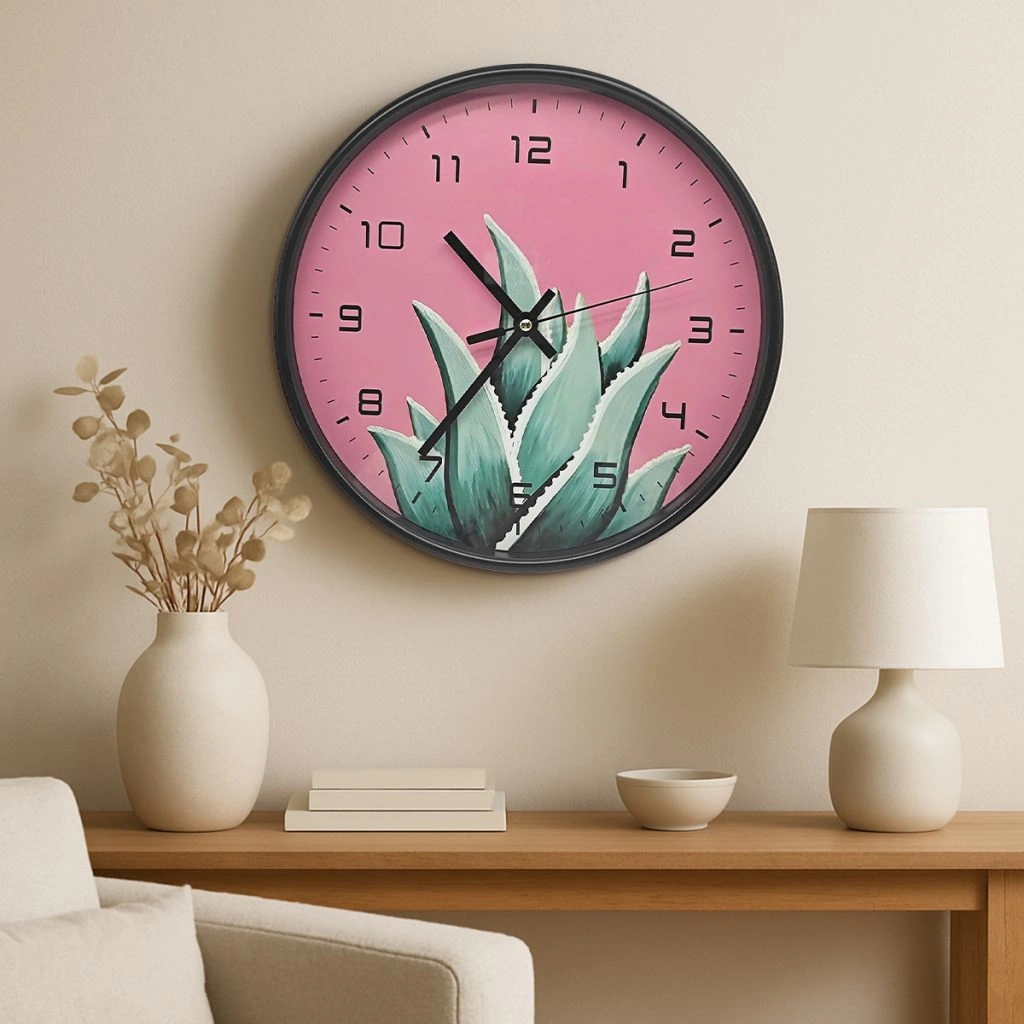
This modern minimalist wall clock can add a measured splash of color to a room with the face of the SZZ0130 modern minimalist decorative wall clock in a choice of colors. This silent quartz wall clock features large clear numerals, a sturdy metal frame, a PP face and metal hands, measuring 30 cm in diameter. Instead of adding several different colors to a room, repeat the face color in a cushion, a work of art, or an accessory.
Keep a minimalist room visually quiet
The SZZ0099 modern minimalist plastic silent wall clock is supplied with silent running and features simple hour indicators on a numberless dial. Supplied: 30 cm diameter x 4cm thick. Features a simple hook on the back of the clock for fixing to the wall. Suitable for living rooms, bedrooms, offices and studies.
Compare the different clock styles by the visual job they do. A clear set of numbers is most important for legibility. A colorful face is a focal point. Subtle hour markers keep the simple dial look. Compare the clocks at the height at which they will hang and from the different locations in the room where the clock will be most seen, as opposed to only comparing by material.
How to Choose Wall Clock Size and Placement
Relate clock diameter to the wall and furniture
Even a small item such as a 30 cm clock can disappear above a deep sofa or look too large placed on a small side table. By marking out the diameter of the clock face with painter’s tape, you can very quickly judge the impact of the item from the room entrance as well as from the main seating area in the room. Allow sufficient space around the frame of the clock so that it reads as a freestanding object and not as a small label. If this is to be a multi-room project, then mock up the furniture at the same height as it will be in the room and test from there as well.
A clock should not be sized based on the width of the wall alone. Consider the area that the clock will frame, including a console, sofa, door, or mirror. The clock may need to be positioned to align with part of this composition rather than the full width of the wall. Compare the diameter of the proposed clock face to the height of the surrounding furniture and allow adequate clearance around the clock face. Use a piece of paper or even just a piece of tape to outline the face, the hour and minute hands, and the numerals to see how they will look from typical viewing positions.
Place the clock in a well-lit area with practical access
Try to avoid having direct glare on the face but make sure the numbers are readable at the main viewing angle. Try to position the clock so it sits below a console, artwork, or other vertical feature and make sure that a shelf does not block the hook or battery access. Check the type of surface the wall is made of and ensure that you have kept the supplied accessories with the approved model. View the clock face in daylight and then view it u nder the evening lights in the room. If the glare is so severe that it hides the hands or numbers, then try to reposition it. If it is not good enough, then compare it with the other face before drilling it into the wall.
In a multi-room property, record the final height and orientation of each clock so that housekeeping can re-place them to view correctly. A short record of how the clocks were placed will also enable the viewer to replicate the same view in other similar rooms.
Are Silent Wall Clocks Right for Bedrooms and Offices?
Read movement descriptions without assuming zero noise
Terms such as silent or non-ticking are often used in product descriptions for wall clocks. These are product-specific descriptions. While the description may lead you to believe that a wall clock is silent, it is not a guarantee that no sound will ever be heard in any situation. Therefore, if sound is a sensitive issue for you, check the specific model you are interested in and see how it sounds in a quiet situation.
Match the clock to the room’s routine
An office would require clear numerals at a distance, while a bedroom would prioritize movement sound and a low-glare face. A living room could have a more expressive face as long as it is readable from the main seating area in the room. Determine which of these needs to prioritize and keep the description of the selected model with your room’s specifications.
What Should Buyers Check Before Ordering Wall Clocks in Bulk?
Confirm the model, sample, and operating details
To use this feature, write down the model, face style, material, diameter and thickness where noted, as well as any movement described, power source, accessories, and intended room. Compare the approved sample to the carton marking prior to a bulk shipment. We support supplier discovery and evaluate a supplier’s capabilities against required standards. We can also assist with samples and prototypes before going into full production. Keep the model code and sample notes together so you can reference back to the approved identity.
SANGNI Commercial Product Coordination covers product sourcing, product design and development, quality control and assurance, stock holding, freight and after-sales service. Thus, for a clock order, it is best to maintain each model line and not treat similar products as interchangeable products.
For multi-room orders, it is particularly important to keep all the approved samples for each model, plus the notes on the carton marking, the battery and accessories supplied, the quantity of replacement clocks required, and all the acceptance evidence for that model. This will enable comparison with the approved model when reordering later, as opposed to having only a photograph of a somewhat similar product.
Define quality checks and replacement stock
We perform pre-production checks, in-process checks, final product checks, packaging checks, loading checks, warehousing, and international logistics checks. None of these checks, however, guarantee 100% defect-free or 100% on-time delivery. Please define the following: packaging checks, replacement items, battery and accessories checklist, and required proof for release for shipping. We will source products with the same model number as approved by you through sampling and subsequent reordering for production. Prior to production, we will agree upon acceptance criteria for dial markings, frame finish, hand clearance, movement starts, packaging, and accessories count. Who will approve the sample, and what is the process for visible deviations from the approved model? The shipment will be reviewed against these criteria.
FAQ
Q: What makes a luxury wall clock look right in a modern interior?
A: The effect of good information design is often based on proportion, clear design, sufficient contrast, the right frame, and adequate placement rather than too much detail.
Q: Are silent wall clocks completely noiseless?
A: Silent or non-ticking in product descriptions should not be taken as a guarantee for all situations and applications.
Q: Which wall clock size should I choose?
A: Compare the clock diameter with the furniture width, wall height, and the distance from which it is to be viewed. Note down the proposed diameter before you place the order.
Q: How do modern minimalist wall clock styles differ?
A: Using a simple and clear dial with numbers as the main feature, adding subtle hour indicators, and using the dial as a controlled accent with color as the main feature.
Q: What should a bulk wall-clock specification include?
A: Detail the model number, material, face type, dimensions, configuration, power supply, options, packaging, and warranty for replacement units.