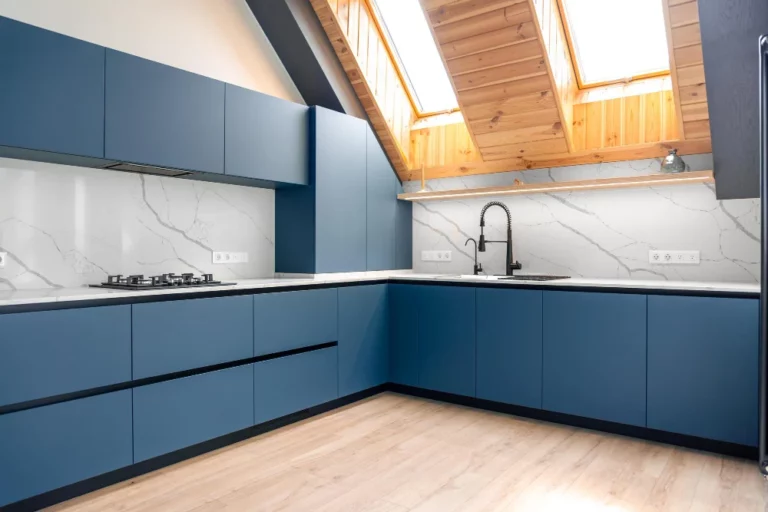

A tile grid is not the only way to give a bathroom a finished look. A large UV board can carry marble veining or a solid color across a wall without the busy pattern of many grout lines. That visual simplicity is appealing, but the bathroom still sets the terms: water at the basin, steam after a shower, and awkward cuts around fittings all have to be planned before anyone falls in love with a sample.
Why UV Board Works in Bathroom Design
Moisture-Aware Surface Planning
A smooth panel gives the eye somewhere to rest, particularly behind a vanity with several mirrors or fittings. Fewer joints are an advantage only if the remaining joints are detailed properly. Inspect the existing wall for damp or loose finishes; mark plumbing access; and decide how corners, penetrations, and the lower edge will be sealed. Ventilation and splash exposure belong on the same drawing as the panel layout.
Do not specify a finish merely because a brochure calls it suitable for bathrooms. A basin splashback and a shower enclosure face different amounts of water. For the latter, get the chosen system’s wet-area instructions and settle the waterproofing, corner and floor transitions, and sealing method with the installer. The decorative face alone cannot do that work.
Cleaning and Visual Continuity
Imagine the view from the doorway. A single pale panel behind the basin may read as one quiet plane; a strongly veined panel makes the same spot a feature. Neither effect requires the entire room to match. Before committing, hold a sample near the mirror and fixtures under the actual lights. Ask how the finish should be cleaned, especially if the room sees cosmetics, soap residue, or frequent housekeeping. Use soft tools unless the product’s care instructions permit something stronger.
Design Ideas Beyond Ceramic Tile
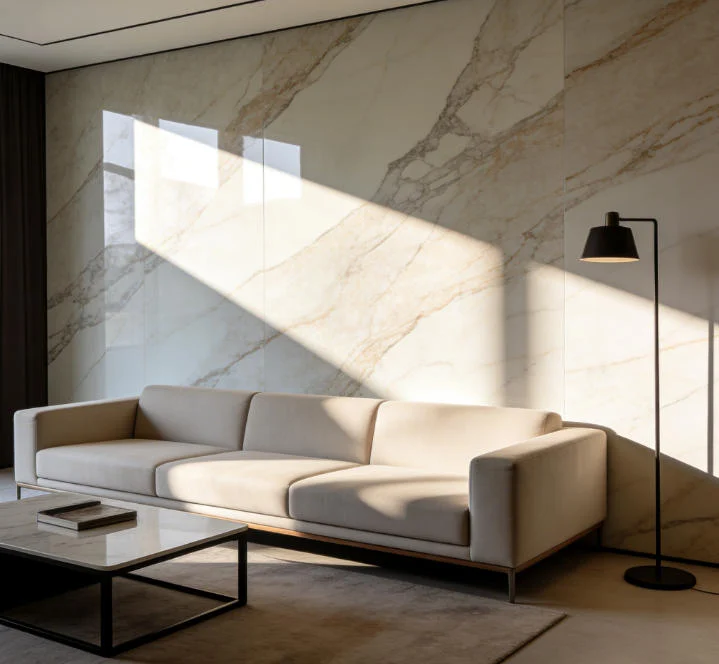
Marble-Look Feature Walls
Marble effects work best when there is room for the pattern to read. Behind a vanity, identify the section that will remain visible after the mirror, sconces, and cabinet are installed. A vein that disappears behind the mirror can make an expensive-looking sheet feel randomly placed. Pick up one tone in the floor or countertop rather than trying to match every fitting. Upright veining can draw attention to height, while a broad horizontal movement may suit a long basin wall.
Repeated veining is easy to miss on a small swatch and obvious over several sheets. Lay out the full elevation, including seams and offcuts, before ordering. Where adjacent panels can be matched, check the batch and orientation; where they cannot, move the joint to a corner or a natural change in plane. A niche or mirror should not accidentally split the strongest part of the design.
Full-Height Color Blocks
A colored panel can do the work that several decorative finishes would otherwise share. Try one deep green or muted blue wall behind a simple white basin, then leave the remaining surfaces restrained. Full-height color often has more presence than a narrow strip; it also avoids a horizontal break at eye level. Guest baths and compact apartment bathrooms are good places to test this approach because the focal wall is visible at once.
How to Plan Panels Around Bathroom Fixtures
Keep Seams Intentional
Start the elevation at the wall people actually see on entry, then work outward. A seam at the edge of a vanity or at a return is easier to accept than one drifting through the center of a mirror. Mark every pipe, outlet, towel rail, control, and removable access cover. Those small interruptions decide whether a large sheet still looks deliberate once the room is in use.
The wall-panel category is a useful starting point for comparing finishes and applications: SANGNI wall panels can be reviewed alongside the room’s moisture and styling requirements. The important question is not simply whether a panel looks attractive, but whether its thickness, edge treatment, substrate, and fixing method suit the installation.
Coordinate Niches and Vanities
A ledge or niche offers a sensible place to end one finish and begin another. Around a basin, the panel might extend from the counter to the ceiling, with the mirror interrupting it. In a bigger bathroom, an inset can distinguish the dressing area from the shower. Make that boundary follow the room’s geometry, not the nominal width of a stock sheet.
A tidy rendering can hide difficult cuts. Ask the installer to show how a tap, an electrical box, or a shower valve will be handled, and keep access to serviceable parts. Trim and sealant should be chosen alongside the board sample. Otherwise, a carefully selected marble effect can be undermined by a conspicuous edge bead.
For multi-room work, SANGNI product sourcing can help coordinate the wall finish with related interior components. Confirm the selected panel’s dimensions and installation details separately.
Choosing the Right Finish and Installation Approach
Gloss, Satin, and Texture
Gloss catches light, which can help a windowless room, yet it also catches reflections from mirrors and reveals a wavy substrate. A satin sample may be easier to live with beside bright fittings. Texture brings relief to a plain wall, but test whether residue lodges in the surface before putting it behind a basin or in a busy washroom.
The term UV board does not identify one universal construction. A UV carbon crystal board has a UV-cured surface layer; other decorative board constructions use an extruded WPC base with laminated PVC, scratch-resistant PP, or high-gloss PET-G films. Ask for the actual substrate and surface stack of the selected panel rather than assuming that the visual sample proves its wet-area performance.
WPC wall-panel constructions may be fixed with fasteners, glue, nails, or clips, depending on the system. These are installation options, not an assurance that every UV-finished board can use every fixing method. Confirm the specified panel’s instructions before planning the edge and joint details.
Adhesive, Substrate, and Edge Details
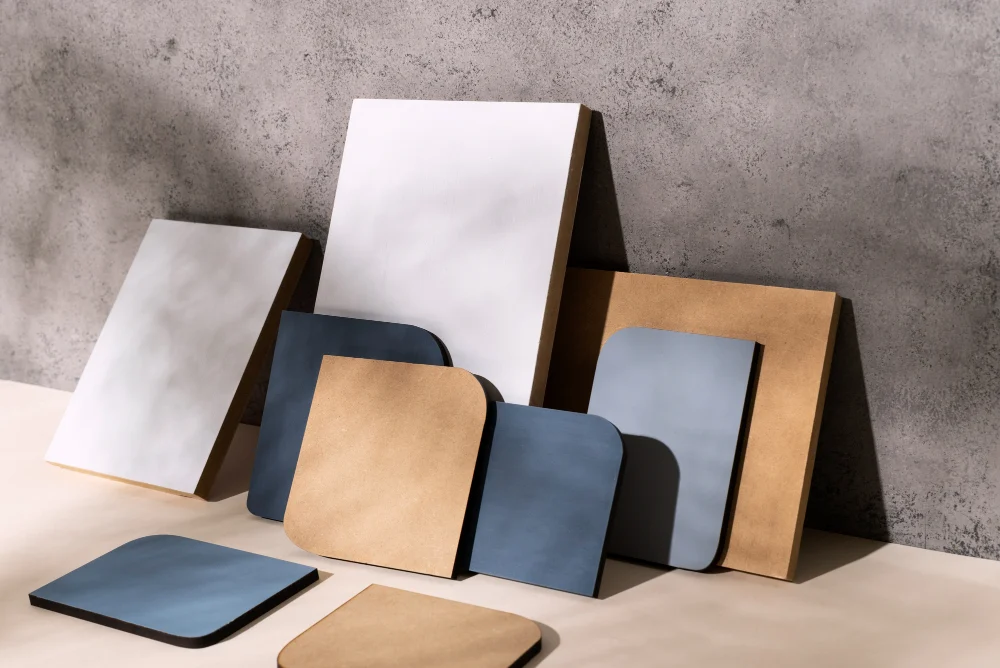
Before any adhesive is opened, check the substrate for loose paint, dust, moisture, and uneven spots. A glossy panel can make a poor wall more conspicuous rather than hiding it. Obtain the fixing instructions for the exact construction: adhesive compatibility, movement allowance, corners, and seals are system details, not universal properties of the phrase UV board.
SANGNI’s building-supplies range covers PVC, WPC, and MDF wall panels alongside skirting boards and other finishing materials. We can help buyers compare product and material directions within a wider home-product sourcing brief. The sourcing service includes supplier selection, production oversight, quality checks, packaging, and logistics coordination; for a multi-room project, ask which of those steps applies to the proposed wall finish.
What SANGNI Can Add to a Bathroom Wall Project
For buyers comparing finishes, the SANGNI product range provides a broader view of wall panels, home decor, and related interior categories. A project team can use that overview to shortlist a visual direction, then confirm the exact substrate, dimensions, edge treatment, packaging, and installation conditions before purchase. The sourcing workflow includes a final product evaluation of dimensions, labeling, packaging, and visible defects before shipment; agree on the inspection criteria for the chosen wall finish early.
Agree on the panel and edge sample before asking for a price across many rooms. Product customization, flexible orders, and market-specific adaptations are part of that sourcing discussion. A finish that looks excellent on one wall can disappoint if the next batch varies visibly or a trim detail was never specified.
FAQ
Q: Is UV board suitable for bathroom walls?
A: It can, but ask for instructions for the exact board and its intended exposure. The wall behind a basin is not the same as the inside of a shower. Waterproofing and ventilation remain separate decisions.
Q: Is UV board better than ceramic tile for a small bathroom?
A: Choose by location and maintenance, not looks alone. UV board can give a broad marble or color field with fewer visible seams. Tile may be the better fit when the project depends on a particular wet-area assembly or an established repair method.
Q: Can UV board be used behind a bathroom vanity?
A: A vanity wall is a useful place to explore a continuous panel. Draw the basin, outlets, and pipe openings first; each cut interrupts the surface and needs an appropriate sealed detail.
Q: How do I clean a UV board bathroom wall?
A: Try a soft cloth and a mild cleaner approved for the selected finish. Do not assume that an abrasive pad or solvent is harmless just because the face feels hard.
Q: What should I check before ordering UV board?
A: Take a measured wall elevation to the supplier. Include seams, pattern direction, fittings, and service access, then request the exact board construction, fixing and sealing instructions, and a sample viewed under the room’s lighting.