
Natural texture and handwoven home products continue to attract attention, but rattan carpet demand is not uniform. A large North American living room, a compact Asian apartment, a European showroom, and a resort project may require different sizes, finishes, material declarations, and ordering methods. For importers, retailers, and procurement teams, the practical questions are where these rugs fit, how customers discover them, and which specifications make them credible in each market.
What Does “Rattan Carpet” Mean in Today’s Natural Rug Market?
True Rattan, Straw, Raffia, and Rattan-Style Woven Rugs
“Rattan carpet” is often a merchandising label, not one precise material. It may describe true rattan fiber, straw, raffia, seagrass, jute, or merely a rattan-like weave. DDH0003 is presented as a handwoven natural-straw carpet made from 100% raffia straw. Its specification emphasizes fiber strength, a smooth organic surface, and a durable woven structure. Because raffia is biodegradable, it is an ideal choice for product lines targeting eco-conscious consumers who prefer clearly identified natural fibers over an unspecified “rattan look”.
Why Accurate Material Labeling Matters to Buyers
Composition affects feel, moisture limits, care, and customer expectations. Construction and backing also change performance. A listing for the DDH0003 Natural Straw Handwoven Rattan Carpet should identify raffia straw, its 120 cm by 180 cm size, and intended indoor use rather than rely on “natural” alone.
Why Is Rattan Carpet Demand Growing Across Home Décor Markets?
Biophilic Interiors and the Shift Toward Natural Texture
Biophilic interiors use recognizable natural materials and tactile surfaces to soften hard rooms. Woven rugs support that direction without requiring a full redesign, giving living areas and wellness corners a warmer, grounded character.
Warm Neutrals, Visible Weaves, and Textured Minimalism
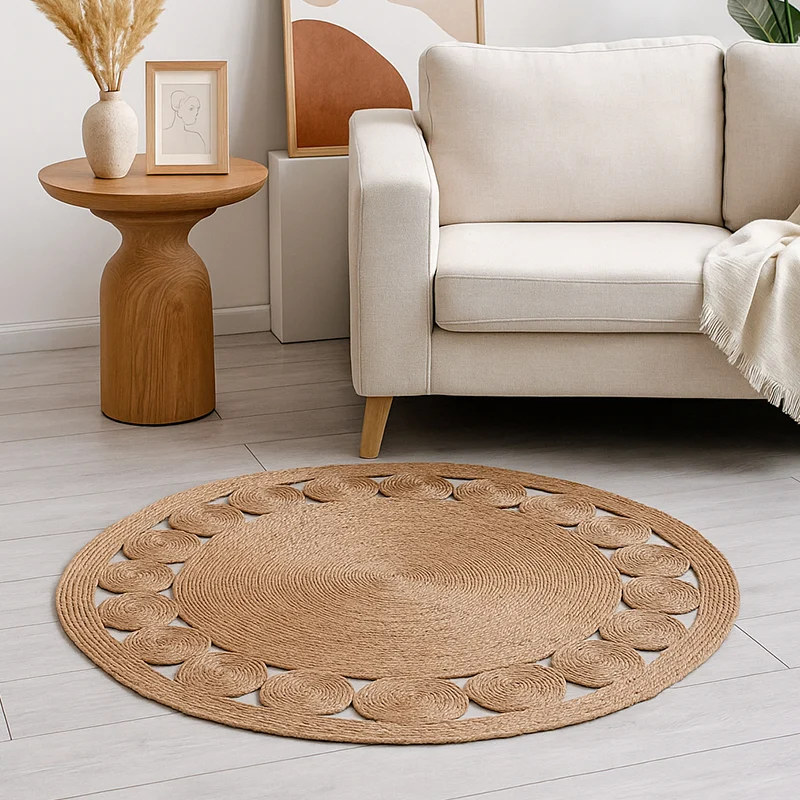
Beige, straw, sand, and pale brown work across minimalist, coastal, farmhouse, and bohemian settings because they add texture without dominating the palette. DDH0004 uses traditional handcraft and 100% natural straw to create a visibly textured, warm surface. Its woven pattern makes the fiber itself part of the design, allowing the rug to add character while staying quiet enough for restrained contemporary rooms.
Handwoven Character in a Mass-Produced Home Market
Visible shifts in fiber tone or pattern rhythm can signal handwork and make a rug feel individual. Commercial buyers still need clearly defined tolerances to distinguish acceptable natural variations from actual defects, such as loose edges, wrong dimensions, contamination, or inconsistent batches.
Where Is Rattan Carpet Demand Strongest by Region?
North America: Large Area Rugs, Natural Styling, and Online Discovery
The broader rug market is well established in North America, where larger living rooms can support substantial area formats. US and Canadian shoppers often discover products through search, social imagery, and marketplaces. Retailers should show scale under furniture and explain whether a weave is decorative, everyday, or limited to light traffic.
Europe: Material Transparency and Understated Contemporary Design
UK, German, French, and Nordic buyers often respond to restrained texture and contemporary neutrals. Fiber identity, backing, origin, care limits, and responsible-sourcing statements should be specific and supportable. Accurate documentation and consistent finishing matter in specialist retail and design-led showrooms.
Asia-Pacific and Australia: Urban Homes, Coastal Living, and Flexible Sizes
In dense Asian cities, small and round formats define a reading or coffee-table zone without crowding circulation. Australia presents a different opportunity: open-plan rooms and coastal styling suit natural texture. In both cases, buyers must confirm whether the chosen fiber and backing tolerate local humidity and intended conditions.
Middle East and Latin America: Hospitality and Emerging Decorative Demand
Demand may develop through hotels, resorts, restaurants, boutique residences, designers, and emerging home-decor retail. Project buyers prioritize custom dimensions, sample approval, edge finish, replacement planning, and protective packaging. A decorative natural rug should not be assumed suitable for high-traffic lobbies or damp leisure areas.
Which Rattan Carpet Styles Fit Different Regional Markets?
Round Rattan Carpets for Apartments and Defined Seating Areas
A round rattan carpet softens the straight lines of walls and furniture, fitting apartments, reading nooks, and coffee-table groups. The DDH0004 Hand-Woven Straw Rattan Carpet shows the expected warm neutral look. For small-room searches, a diameter diagram and furniture-scale photograph are far more effective than relying on vague product descriptions.
Large Neutral Rattan Area Rugs for Open-Plan Interiors
Rectangular, oval, and low-pattern rugs can organize open living rooms, dining zones, or lounges. Size should follow furniture placement, door clearance, and walking paths. Large woven pieces also raise questions about rolling, carton dimensions, container planning, and edge stability.
Custom Woven Rattan Carpets for Hospitality and Design Projects
Hotels, restaurants, model homes, and studios often need custom dimensions, edge treatments, approved patterns, and repeatable batch color. Samples confirm fiber, hand feel, binding, backing, and allowable variation. Maintenance routines, traffic, and moisture exposure should guide approval.
Which Sales Channels Are Driving Rattan Carpet Purchases?
Online Marketplaces and Direct-to-Consumer Websites
Online buyers cannot touch the weave, so the visual presentation must do the heavy lifting. Pages need detail images, room scenes, dimensions, exact materials, backing, care guidance, and packaging information. Single-item cartons must protect shape and edges, while listings should disclose normal shade or handwoven variation.
Specialty Rug Stores and Home Décor Showrooms
Showrooms turn texture into an advantage. Customers can compare straw, raffia, jute, and rattan-like weaves, view color in real light, and judge firmness. Staff can explain scale, placement, care, and moisture limits.
Wholesalers, Importers, and Regional Distributors
Trade channels need stable assortments, repeatable specifications, batch control, practical carton plans, and reliable replenishment. Regional exclusives or coordinated size series can limit direct price comparison. Buyers should confirm mixed loading, packing density, lead time, inspection criteria, and replacement matching.
Interior Designers and Hospitality Procurement Channels
Designers and contract buyers work to schedules and room-by-room quantities. They need labeled samples, signed specifications, controlled color ranges, and protective packaging. Timelines should include sample revisions, production, inspection, consolidation, delivery, and site access.
How Can B2B Buyers Source Rattan Carpet for Regional and Channel Fit?
Match Materials and Sizes to Climate, Room Use, and Customer Expectations
There is no universal global assortment. Buyers should match fiber and construction to humidity, cleaning, traffic, foot feel, home size, and price position. Compact raffia mats and large open-plan formats serve different customers, so channel expectations should shape the range.
Verify Weave Consistency, Backing, Moisture Limits, and Product Claims
Check fiber claims, weave density, loose ends, dimensions, stains, edges, backing, slip control, and batch variation. The DDH0002 Natural Rattan Carpet provides a backing example: its non-woven fabric layer is intended to improve grip, protect the floor, and give the rug a more secure base.
Plan Samples, Packaging, Customization, and International Delivery
SANGNI is a home-goods sourcing agent, not the original designer or manufacturer of every rug it helps procure. We leverage deep market insights and a vetted supplier network to source and deliver home and building products through a coordinated, cost-conscious procurement process. Our support can include supplier screening, sample coordination, multi-step product inspection, customization, packaging, consolidation, customs-clearance coordination, and international delivery. This lets us adapt the workflow to an online assortment, a wholesale program, or a project schedule without implying that every product is our own design or production.
FAQ
Q: Is every rattan carpet made from true rattan?
A: No. It may describe true rattan, straw, raffia, jute, seagrass, blended fibers, or a rattan-style weave. Rely on the stated composition and verified sample.
Q: Which rattan carpet size works best for a small living room?
A: A round or compact rectangular rug can work around a coffee table or reading chair. Measure the furniture group and walking clearance before choosing the shape.
Q: Can a natural rattan carpet be used in humid climates?
A: Sometimes, but suitability depends on fiber, backing, airflow, cleaning, and moisture exposure. Request written limits and test the proposed construction rather than assuming universal suitability.
Q: What information matters most for selling rattan carpet online?
A: Show accurate materials and backing, close-up weave images, room scenes, dimensions, care instructions, and natural-variation notes. Packaging should protect shape and edges.
Q: What should B2B buyers approve before a bulk rattan carpet order?
A: Approve material, size tolerance, weave, color range, edges, backing, labels, cartons, samples, inspection standards, production schedule, delivery plan, batch consistency, and replacement requirements.